The Problem We Solve

AI advice is noisy. You want working AI systems that save time, offer excellent services, and grow customers/revenue. We provide:

  • External: Hard to find reliable, real world AI examples.

  • Internal: Overwhelmed by vague AI advice and wasted time.

  • Philosophical: You should not have to navigate AI alone.

Your Next Step – Join the learning community for:

Self-paced, Short  audio/video topics, lessons to help you and your organization have the skills to:

  • Understand important AI concepts

  • Secure AI systems using various technical controls

  • Leverage AI to enhance organization security posture while automating security tasks

  • Understand how governance, risk, and compliance (GRC) impacts AI technologies on both an organizational and global scale

What you get is:

  • 71 video lectures (8+ hours)

  • 69 detailed audio lectures (15+ hours)

  • 50% off on companion book (500+ page reference)

  • Cohort/community mentoring and learning

  • $90  $45 introductory price if you join the wait list now ($45 savings on enrollment)

© 2026 ThisLocale LLC. All rights reserved. Author: James M Dutcher Publisher: ThisLocale LLC ISBN: 979-8-9943522-0-5 Licensed for individual use only. No part of this book may be reproduced or transmitted in any form without written permission, except for brief quotations used in reviews.

Concepts and Content

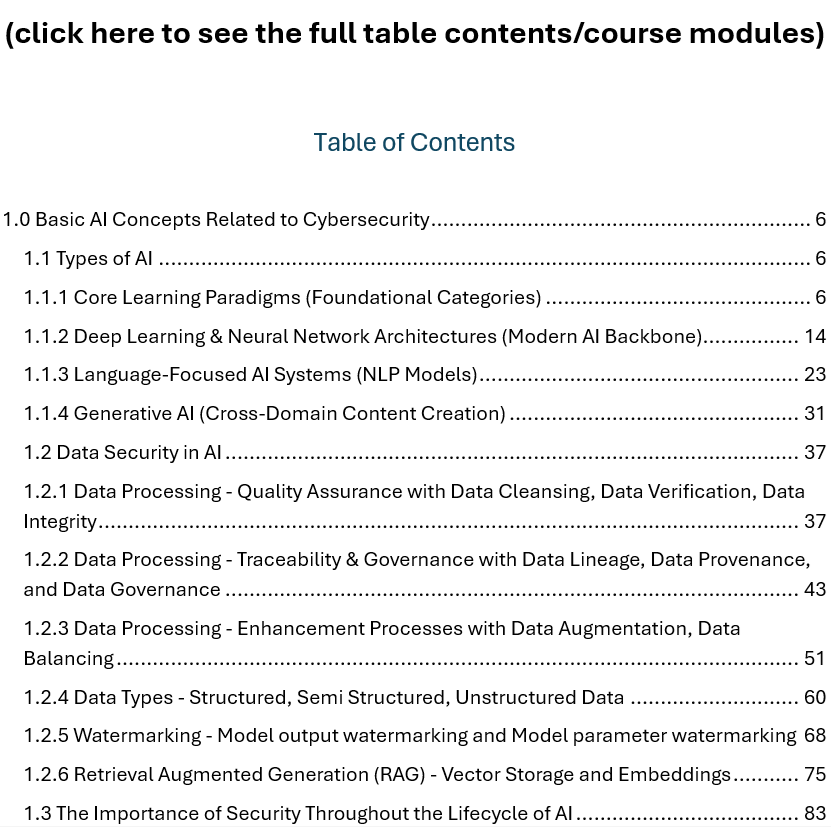
1.0 Basic AI Concepts Related to Cybersecurity. 

1.1 Types of AI 

  • 1.1.1 Core Learning Paradigms (Foundational Categories) 
  • 1.1.2 Deep Learning & Neural Network Architectures (Modern AI Backbone) 
  • 1.1.3 Language-Focused AI Systems (NLP Models) 
  • 1.1.4 Generative AI (Cross-Domain Content Creation) 


1.2 Data Security in AI 

  • 1.2.1 Data Processing – Quality Assurance with Data Cleansing, Data Verification, Data Integrity. 
  • 1.2.2 Data Processing – Traceability & Governance with Data Lineage, Data Provenance, and Data Governance. 
  • 1.2.3 Data Processing – Enhancement Processes with Data Augmentation, Data Balancing. 
  • 1.2.4 Data Types – Structured, Semi Structured, Unstructured Data. 
  • 1.2.5 Watermarking – Model output watermarking and Model parameter watermarking. 
  • 1.2.6 Retrieval Augmented Generation (RAG) – Vector Storage and Embeddings. 


1.3 The Importance of Security Throughout the Lifecycle of AI 

  • 1.3.1 Secure AI Strategy and Governance. 
  • 1.3.2 Secure and Trusted Data Foundations. 
  • 1.3.3 Secure Model Engineering and Risk Controls. 
  • 1.3.4 Secure Deployment and Operational Defense. 
  • 1.3.5 Secure Feedback, Audit, and Continuous Improvement 


1.4 Bad Actors’ Use of AI in Cyber Attacks. 

2.0 Securing AI Systems. 

2.1 AI Threat-Modeling Resources. 

  • 2.1.1 Explaining AI Threat-Modeling Resources. 
  • 2.1.2 Scenario Using AI Threat-Modeling Resources. 


2.2 Building a Secure AI 

  • 2.2.1 Requirements Phase Implementing Model-Level Security and Control Design. 
  • 2.2.2 Requirements Phase Using Guardrail Assurance, Testing, and Validation. 
  • 2.2.3 Requirements Phase with API Gateway Security and Interaction Controls. 


2.3 Scenario Implementing Appropriate Access Controls for an AI System.

2.4 Implement Data Security Controls for AI systems. 

  • 2.4.1 Encryption requirements. 
  • 2.4.2 Scenario Using Encryption Requirements. 
  • 2.4.3 Data Safety. 
  • 2.4.4 Scenario on Data Safety. 


2.5 Monitoring and Auditing AI Systems. 

  • 2.5.1 Capture & Observe AI Activity. 
  • 2.5.2 Scenario on Capture & Observe AI Activity. 
  • 2.5.3 Generate & Process Logs. 
  • 2.5.4 Scenario on Generating and Processing Logs. 
  • 2.5.5 Analyze Model Behavior 
  • 2.5.6 Scenario on Analyzing Model Behavior 
  • 2.5.7 Audit Model Output for Risks. 
  • 2.5.8 Scenario on Auditing Model Output for Risks. 


2.6 Analyze Evidence of an Attack and Implement Compensating Controls for AI Systems. 

  • 2.6.1 Identifying the Attack Indicators. 
  • 2.6.2 Scenario on Identifying the Attack Indicators. 
  • 2.6.3 Analyzing the Attack Surface & Classify the Attack Type. 
  • 2.6.4 Scenario on Analyzing the Attack Surface & Classify the Attack Type. 
  • 2.6.5 Identifying Direct Model-Targeted Attacks. 
  • 2.6.6 Scenario for Identifying Direct Model-Targeted Attacks. 
  • 2.6.7 Determining Root Cause and Evidence Strength. 
  • 2.6.8 Scenario for Determining Root Cause and Evidence Strength. 
  • 2.6.9 Applying Compensating Controls. 
  • 2.6.10 Scenario for Applying Compensating Controls. 


3.0 Al-assisted Security. 

3.1 Tools to Facilitate Security Tasks. 

  • 3.1.1 Using Al-Enabled Tools to Facilitate Security Tasks. 
  • 3.1.2 Scenario for Using Al-Enabled Tools to Facilitate Security Tasks. 
  • 3.1.3 Use Cases for Using Al-Enabled Tools to Facilitate Security Tasks. 
  • 3.1.4 Scenario on Use Cases for Using Al-Enabled Tools to Facilitate Security Tasks. 


3.2 How AI Enables or Enhances Attack Vectors. 

  • 3.2.1 AI-Enhanced Identity & Influence Attacks. 
  • 3.2.2 AI-Driven Reconnaissance and Target Discovery. 
  • 3.2.3 AI-Enabled Evasion & Obfuscation Techniques. 
  • 3.2.4 AI-Automated Attack Construction & Operations. 
  • 3.2.5 Scenario of How AI Enables or Enhances Attack Vectors. 


3.3 Using AI to Automate Security Tasks. 

  • 3.3.1 Enhanced Automation & Scripting Foundations. 
  • 3.3.2 Scenario on Enhanced Automation & Scripting Foundations. 
  • 3.3.3 AI for Knowledge Processing & Operational Intelligence. 
  • 3.3.4 Scenario on AI for Knowledge Processing & Operational Intelligence. 
  • 3.3.5 AI-Automated Incident & IT Operations Management 
  • 3.3.6 Scenario on Using AI-Automated Incident & IT Operations Management 
  • 3.3.7 AI-Integrated DevSecOps – CI-CD Security Pipeline. 
  • 3.3.8 Scenario on AI-Integrated DevSecOps – CI-CD Security Pipeline. 


4.0 AI Governance, Risk, and Compliance. 

  • 4.1 Organizational Governance Structures that Support AI 
  • 4.1.1 AI Organizational Structures for Secure AI Systems. 
  • 4.1.2 AI Development and Engineering Roles. 
  • 4.1.3 AI Security, Risk, and Governance Roles. 


4.2 Risks Associated with AI 

  • 4.2.1 Responsible AI (Risk Reduction and Mitigation Controls) 
  • 4.2.2 AI and the Core AI Risks (Threats and Exposure Categories) 
  • 4.2.3 Shadow AI (Autonomous & Unapproved AI Systems) 


4.3 The Impact of Compliance on Business Use and Development of AI 

  • 4.3.1 External Laws, Regulations, and Global Standards. 
  • 4.3.2 Internal Organizational Governance and Policy Controls. 


© 2026 ThisLocale LLC. All rights reserved.


Author: James M Dutcher

Publisher: ThisLocale LLC

ISBN: 979-8-9943522-0-5


Licensed for individual use only. No part of this content (website, course, or book) may be reproduced or transmitted in any form without written permission, except for brief quotations used in reviews.